 blog
blog
Mobile Mechanic Cost in Florida: What to Expect
Table of Contents
- What Affects Mobile Mechanic Cost
- Understanding Mobile Mechanic Diagnostic Fees
- Mobile Mechanic vs. Repair Shop Cost Comparison
- Getting a Mobile Mechanic Repair Estimate
- Key Questions to Ask a Mobile Mechanic
- Why Choose a Certified Mobile Mechanic
- Frequently Asked Questions
Last Updated: October 14, 2026
What Affects Mobile Mechanic Cost
Several factors determine your final bill, and you can predict costs once you understand what matters most.
Repair Type and Complexity
Simple repairs cost less than complicated ones. An oil change takes 30 minutes; an engine diagnostic with multiple systems to test takes hours.
Common repairs vary widely in scope:
- Oil and filter changes: straightforward, quick work
- Brake pad replacement: moderate complexity, requires some disassembly
- Engine diagnostics: time-intensive, requires specialized equipment
- Electrical system repairs: highly variable, depends on the issue
- A/C service: moderate to complex, often needs refrigerant and parts
At Chris Automotive Repair Service, customers understand costs better when they know what's involved. Diagnosing a check engine light means connecting equipment and interpreting results; replacing brake pads is mostly physical labor.
Vehicle Make, Model, and Age
Newer vehicles sometimes cost more to repair than older ones. Modern cars have complex electronics, while older vehicles may have simpler systems but harder-to-find parts.
Make and model matter too. Some vehicles have easy-to-access parts; others require removing multiple components just to reach the problem area, which adds labor time.
Parts and Labor Breakdown
Your total bill splits into parts and labor. Understanding this split helps you evaluate quotes fairly.
Labor is where mobile mechanic cost varies most.
Understanding Mobile Mechanic Diagnostic Fees
A diagnostic fee covers identifying what's wrong with your vehicle. The technician connects scan tools, runs tests, and interprets live data, skilled work that separates a real repair from a guess.
How diagnostic fees are typically structured
Mobile mechanics and shops use a few common models. Ask which one applies before the technician arrives:
- Flat diagnostic fee, credited toward the repair. You pay a set fee for the diagnosis. If you approve the repair, that fee is applied to the final bill. This is the most customer-friendly model and the one most mobile mechanics prefer.
- Flat diagnostic fee, not credited. You pay for the diagnosis whether or not you proceed. Common when the customer declines the repair or wants a second opinion.
- Hourly diagnostic time. The technician bills for actual time spent testing. This is more common on electrical gremlins, intermittent no-starts, and drivability complaints where the cause is not obvious.
- No separate fee, built into the repair. The diagnostic cost is folded into the labor for the job. This looks cheaper upfront but can hide the true cost if you decline the work.
What the fee actually pays for
A proper diagnosis is not just plugging in a code reader. A code reader tells you which system flagged a fault; a diagnosis tells you why.
A thorough diagnostic typically includes:
- Scanning all modules, not just the engine computer
- Reading freeze-frame data to see conditions when the fault set
- Visual inspection of the affected circuit or component
- Testing the component and its wiring before condemning either
- A road test when the complaint is drivability-related
Why mobile diagnostics can cost less than a shop
A shop pays for the bay, lift, utilities, and front-office staff whether your car is there or not; a mobile mechanic has none of that overhead. The trade-off: some diagnostics require a lift or specialized scan tool, and a good mobile mechanic will tell you so rather than guess.
Diagnostics are worth the cost
A proper diagnosis prevents you from paying for unnecessary repairs. A technician guessing might replace the wrong part, sometimes more than once, while a diagnostic identifies the actual issue so you pay only for what you need.
Mobile Mechanic vs. Repair Shop Cost Comparison
Most pricing guides stop at "mobile is cheaper because overhead is lower." That's true but not useful when you're staring at a quote. What helps is comparing the same job three ways: mobile mechanic, independent shop, and dealership.
The overhead math, in plain terms
A dealership carries a building, lifts, a parts department, service writers, and manufacturer-mandated equipment; an independent shop carries a smaller version of the same; a mobile mechanic carries a truck, tools, and a phone. That difference shows up in the labor rate.
Like-for-like comparison for common jobs
Here's how the same repair tends to break down across the three options. Ranges are broad on purpose, parts quality, vehicle access, and rust all move the number.
| Job | Mobile mechanic | Independent shop | Dealership |
|---|---|---|---|
| Oil and filter change | Lowest total; no shop fee, no disposal markup | Mid; shop supplies and disposal added | Highest; often bundled with a multi-point inspection |
| Brake pads and rotors (one axle) | Labor billed at mobile rate; parts sourced to your spec | Mid labor rate plus shop supplies | Highest labor rate; OEM parts priced at dealer markup |
| Battery replacement | Quick; often done in your driveway | Mid; includes terminal service | Highest; includes a diagnostic charge |
| Alternator or starter replacement | Labor-intensive but doable mobile on most vehicles | Mid; lift makes access easier on some models | Highest; OEM part plus dealer labor |
| Check engine light diagnosis | Flat or hourly diagnostic, credited if you approve the repair | Flat diagnostic, sometimes credited | Highest diagnostic fee; often required before any repair |
| A/C recharge and leak check | Doable mobile if the system is accessible | Mid; shop has recovery equipment | Highest; OEM refrigerant and dealer equipment |
When mobile service actually costs more
Honesty matters here. Mobile is not always cheaper:
- Jobs that need a lift. Some repairs require the vehicle raised and supported in a way a driveway cannot safely match. A shop is the right call.
- Jobs that need a specialized scan tool or programming. Module programming and some relearn procedures require manufacturer software. Not every mobile setup has it.
- Jobs where the part is dealer-only. If the part must come from the dealer, the parts cost is the same no matter who installs it, the savings come only from labor.
- Long-distance travel. If you are outside the mechanic's normal service area, a travel charge can erase the labor savings.
When mobile service clearly wins
- Routine maintenance. Oil changes, brakes, batteries, filters, and belts are all well-suited to mobile work.
- Diagnostics. A mobile diagnostic avoids the tow and the shop's diagnostic minimum.
- Fleet and multi-vehicle work. One visit, multiple vehicles, no downtime.
- Anyone who cannot easily get to a shop. No rental car, no ride-share, no waiting room.
The warranty question
A common worry is that mobile work isn't backed like shop work. That depends on the mechanic. A reputable mobile mechanic provides a written warranty on parts and labor, just like a shop.
Chris Automotive Repair Service brings ASE certification and 15+ years of experience directly to your location, with written estimates and warranties. If you're weighing mobile against a shop, call and ask for a quote on the specific job, you'll know exactly what you're comparing.
Getting a Mobile Mechanic Repair Estimate
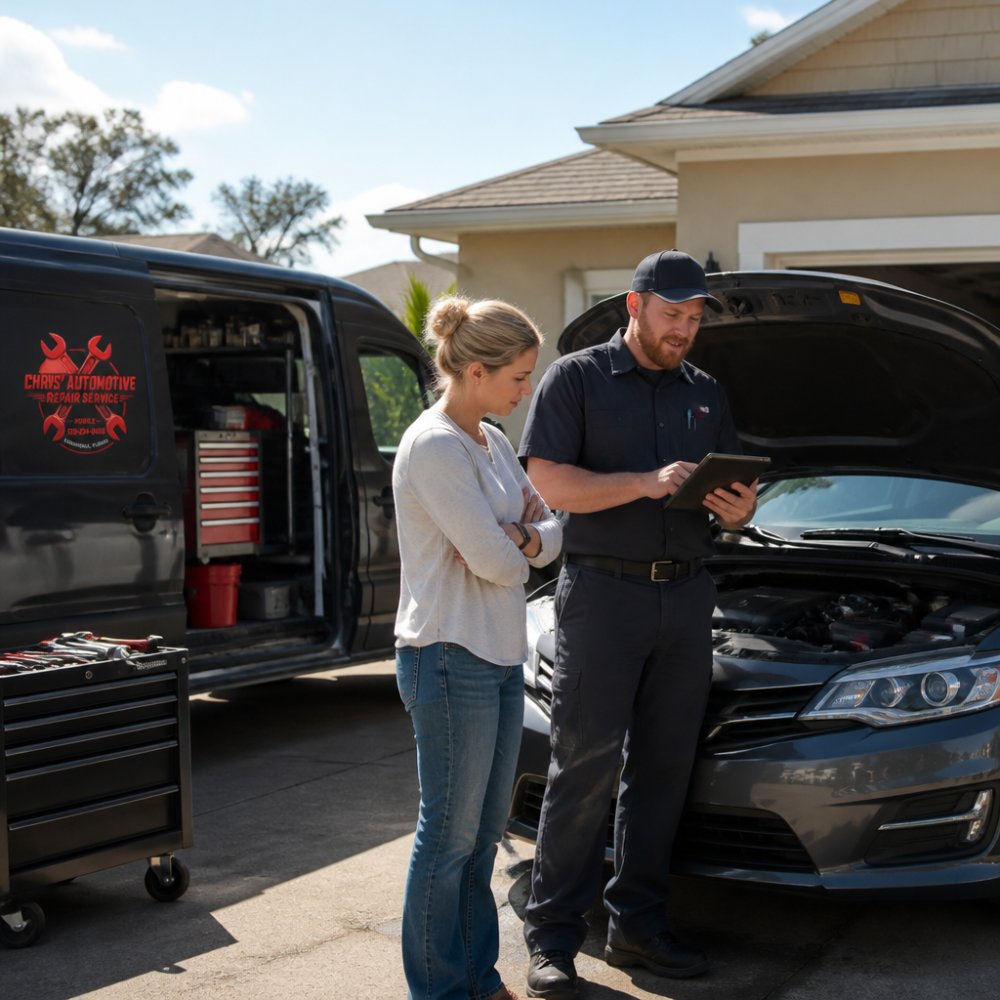
A solid estimate protects you. It shows the work needed and the cost before labor begins. A written estimate is your agreement with the technician.
What to Include in Your Request
When you contact a mobile mechanic, provide:
- Your vehicle's year, make, model, and current mileage
- The problem you're experiencing (noises, warning lights, performance issues)
- When the problem started and how often it occurs
- Any recent service history or previous repairs
- Whether you have a preferred parts brand or quality level
The more detail you provide, the more accurate the estimate. A technician can't quote fairly without knowing what they're working with.
Written Quotes and Warranties
Always get a written estimate, email or text is fine. What matters is documentation of what was quoted and what the technician agreed to do.
A written quote should include:
- Description of the repair or service
- Parts that will be replaced or serviced
- Estimated labor hours or flat rate
- Total estimated cost
- Warranty period for parts and labor
- Timeline for completion
Warranties protect you after the work is done. A parts warranty covers defects in the part itself; a labor warranty means the technician stands behind the work and fixes issues within the warranty period at no additional cost. Chris Automotive Repair Service provides written estimates and warranties on all work.
Key Questions to Ask a Mobile Mechanic
Before you hire someone, ask these questions. The answers tell you whether you're working with a professional.
What certifications do you have? ASE certification is the industry standard. It means the technician passed rigorous exams and meets ongoing education requirements.
How long have you been doing this? Experience matters. A technician with 15+ years has seen most problems before.
What's your warranty on parts and labor? A reputable mechanic stands behind their work. They offer warranties because they're confident in the quality.
Do you provide a written estimate before starting work? This protects you both. You know the cost upfront. The technician has a clear scope of work.
What happens if I don't approve the repair? A professional doesn't pressure you.
Are you insured? Mobile mechanics should carry liability insurance. It protects you if something goes wrong.
Can you provide references? Ask for contact information from recent customers. Real feedback from real people matters.
Why Choose a Certified Mobile Mechanic
ASE certification isn't just a credential, it's proof a technician has demonstrated professional-level competence. ASE (Automotive Service Excellence) tests cover multiple vehicle systems and repair types, and passing requires both knowledge and hands-on skill.
Experience and certification together create confidence. When Chris Automotive Repair Service arrives with 15+ years of hands-on experience and ASE certification, you're getting someone who has solved thousands of problems. Certified mechanics charge fairly because they're confident in their work, they don't need to pad estimates or recommend unnecessary repairs.
Getting an accurate mobile mechanic cost in your area starts with understanding what drives pricing: repair type, vehicle specifics, parts availability, and the technician's experience and certifications.
When you're ready for a quote, Chris Automotive Repair Service provides transparent estimates and professional service throughout Polk County, Florida. We bring ASE certification and 15+ years of experience directly to your location, Monday through Friday.
Frequently Asked Questions
How much should I pay a mobile mechanic?
Mobile mechanic pricing depends on the repair type, your vehicle's make and model, parts needed, and travel distance. Labor rates vary widely based on technician experience and certification level. The best approach is to contact a qualified mobile mechanic with ASE certification for a personalized quote based on your specific repair needs. This ensures you get an accurate estimate rather than guessing at general ranges.
Do mobile mechanics charge a call-out or diagnostic fee?
Many mobile mechanics charge a diagnostic fee to evaluate your vehicle's issue. This fee typically applies toward the total repair cost if you proceed with service. Some technicians waive the diagnostic charge if you book the repair the same day. Always ask upfront whether a diagnostic fee applies and whether it's credited to your final bill. A reputable mobile mechanic will be transparent about all charges before arriving at your location.
Is a mobile mechanic cheaper than a repair shop?
Mobile mechanics often have lower overhead costs. However, total cost depends on the specific repair, parts availability, and your location. Mobile service adds convenience, which some vehicle owners value highly. Request estimates from both to compare, and factor in the time saved by having service come to you rather than driving to a repair facility.
What questions should I ask a mobile mechanic before booking?
Ask about their ASE certifications, years of experience, warranty on repairs, diagnostic fees, parts sourcing, and whether they handle your vehicle type. Confirm they service your area and their availability. Request a written estimate before work begins. Ask how they handle parts that need to be ordered and whether the total price includes labor and materials. These questions help you evaluate whether a mobile mechanic is right for your needs and budget.