 how-to
What to Check When a Car Will Not Start at Home
Table of Contents
- Does Your Engine Crank or Stay Silent?
- Inspect Battery Condition and Charge
- Check Battery Terminals and Electrical Connections
- When Your Car Won't Start But Has Power
- Understanding Why Your Car Clicks But Won't Start
- Engine Cranks But Won't Start: Fuel and Spark Checks
- How to Jump-Start a Car Safely
- When to Stop Troubleshooting and Call a Mechanic
- Frequently Asked Questions
Last Updated: October 18, 2026
Does Your Engine Crank or Stay Silent?
When your car will not start, listen first. The sound the engine makes, or doesn't make, when you turn the key splits every no-start problem into three families, each with its own short list of checks. Skip this and you'll waste time testing spark plugs on a car with a dead battery.
Turn off the radio and fan and listen from the driver's seat, then classify what you hear into one of three buckets.
Bucket 1: No Crank (Silence or a Single Click)
The starter motor is not turning the engine. You may hear nothing at all, one solid clunk, or a rapid machine-gun-style clicking. This is almost always an electrical problem: battery charge, battery terminals, ground straps, the starter solenoid, the neutral safety switch, or the ignition switch itself.
Run these checks in order:
- Turn on the headlights and watch their brightness while a helper turns the key. If the lights dim hard or go out, the battery is discharged or the connection is bad. If the lights stay bright and nothing happens, the battery has power and the fault is downstream, starter, solenoid, or switch.
- Inspect and wiggle both battery terminals. A terminal that moves by hand is a no-start waiting to happen.
- Confirm the shifter is fully in Park (or Neutral). Nudge it and try again.
- If you drive a push-button vehicle, hold the brake pedal firmly and press the button with the key fob itself against the button, many fobs have a dead-battery workaround that lets the immobilizer read the chip.
Bucket 2: Slow Crank (Ruh-ruh-ruh, Then Either Fires or Quits)
The starter turns the engine, but lazily, the classic weak-battery signature and the easiest bucket to diagnose at home. A battery reading around 12.4 volts at rest is roughly half-charged; 12.0 volts or lower is deeply discharged. Cold mornings, a battery over three to five years old, and short trips that never let the alternator recharge are the usual culprits.
Run these checks:
- Load-test the battery with a multimeter (see the battery section below for exact steps).
- Look for corrosion on the terminals, white, blue, or green crust blocks current.
- If the engine eventually fires after a slow crank, drive it for at least 20 minutes at highway speed before shutting it off, or the next start will be just as lazy.
Bucket 3: Normal Crank, No Start (Ruh-ruh-ruh-ruh, But It Never Fires)
The starter is healthy and the battery is fine, but the engine spins at normal speed without catching. Now you're in fuel, spark, air, or compression territory, or an immobilizer that has disabled the ignition.
Run these checks:
- Watch the dashboard: a flashing or solid security/key icon usually means the immobilizer isn't recognizing the key. Try the spare fob.
- Turn the key to ON (not START) and listen for a two-to-three-second whir from the fuel tank, that's the pump priming. Silence points to a fuel pump or relay fault.
- Check the fuel gauge and, if you're below a quarter tank on a steep driveway, add fuel, fuel starvation on an incline is a real and common cause.
Once you've placed your car in a bucket, jump to the matching section: Bucket 1 or 2, start with the battery; Bucket 3, start with fuel and spark.
Inspect Battery Condition and Charge
A weak or dead battery is the most common reason a car will not start, but "check the battery" is useless unless you know what to measure. A basic digital multimeter turns this from guesswork into a two-minute test.
Step 1: Visual Inspection (30 Seconds)
Pop the hood and look at the battery first.
- Age: Most batteries have a date sticker or a stamped code on the case. A battery over three to five years old is on borrowed time, especially in a hot climate where under-hood temperatures accelerate plate degradation.
- Case condition: A swollen, cracked, or leaking case means the battery is done and must be replaced, do not attempt to charge or jump it.
- Terminals: White, blue, or green crusty buildup is corrosion. It acts as an insulator and can mimic a dead battery even when the battery is healthy.
Step 2: Resting Voltage Test (2 Minutes)
Set a multimeter to DC volts (straight line over a dashed line, typically the 20V range).
- Make sure the engine and accessories have been off for at least an hour, or overnight if possible, a just-driven battery reads artificially high.
- Touch the red probe to the positive (+) post and the black probe to the negative (−) post.
- Read the number.
What the reading means:
| Resting Voltage | State of Charge | What To Do |
|---|---|---|
| 12.6V or higher | Fully charged | Battery is likely fine, look elsewhere |
| 12.4V | About 50% charged | Charge it and retest; investigate why it drained |
| 12.0V-12.3V | Deeply discharged | Charge fully, then load-test |
| Below 12.0V | Effectively dead | Charge or replace; do not keep cranking |
A reading of 10.5V or lower under load (while cranking) is a strong sign the battery has failed internally, even if it reads fine at rest.
Step 3: Cranking Voltage Test (1 Minute)
With the meter connected, have a helper turn the key to START while you watch the display. A healthy battery stays above about 9.6V during cranking; below that, the battery is weak or the starter is drawing too much current.
Step 4: Charging System Sanity Check (1 Minute)
If the engine starts, leave the meter connected and check voltage at idle with the headlights on. A healthy alternator holds roughly 13.5V to 14.5V; a reading near 12.5V means it isn't charging and the battery will keep dying.
When the Battery Passes But the Car Still Won't Start
If your battery reads 12.6V at rest, holds above 9.6V while cranking, and the terminals are clean and tight, move on to the starter circuit (Bucket 1) or fuel and spark (Bucket 3).
Check Battery Terminals and Electrical Connections
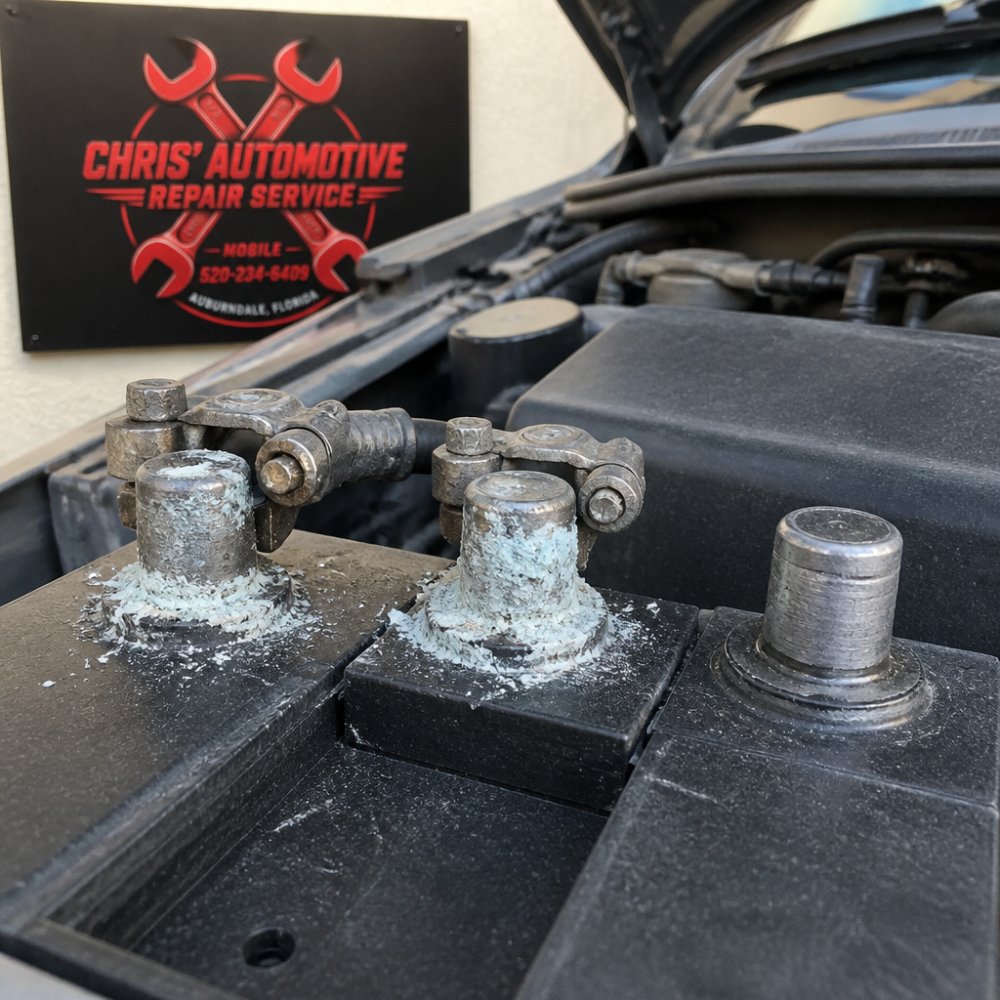
Corroded or loose battery terminals cause a huge percentage of no-start problems, corrosion insulates and blocks the path from battery to starter.
Here's what to look for:
- White, blue, or green crusty buildup on either terminal
- Loose cable connections that move when you tug gently
- Damaged or frayed cable insulation
To clean corrosion, disconnect the negative cable first, then the positive. Scrub the terminals and cable ends with a baking-soda-and-water paste and an old toothbrush, rinse, and dry thoroughly.
Tighten both connections firmly, they shouldn't move when you tug. A loose connection is as bad as corrosion.
When Your Car Won't Start But Has Power
Your lights, radio, and dashboard work, but when you turn the key, nothing happens, a different problem than a dead battery.
You have power, but the starter isn't engaging, a bad starter, faulty solenoid, broken neutral safety switch, or corroded ground cable.
Check that the transmission is in Park (automatic) or Neutral (manual), some vehicles won't start in any other gear.
Understanding Why Your Car Clicks But Won't Start
A rapid clicking when you turn the key means the battery lacks power to turn the starter, the solenoid tries to engage, but voltage is too low to hold the connection.
This almost always means a weak or dead battery, or badly corroded terminals blocking current, enough charge for lights and accessories, but not enough to crank.
Turn off all accessories and try again, sometimes that frees just enough power to turn the engine over. If clicking persists, the battery needs charging or replacement.
Engine Cranks But Won't Start: Fuel and Spark Checks
Your engine turns over smoothly but won't fire, so the starter and battery are fine. Now troubleshoot fuel delivery and ignition.
Check fuel delivery:
- Turn the key to "on" without starting. Listen for the fuel pump to run for a few seconds.
- Smell near the fuel injectors. You should detect a faint gasoline smell if fuel is being sprayed.
- Check the fuel filter if your vehicle has an accessible one. A clogged filter starves the engine of fuel.
Check spark:
- Modern vehicles make this harder to verify without a spark plug tester, but you can try this: remove a spark plug and examine it. Black and wet means too much fuel. Bone dry could mean no fuel or no spark.
- If you have access to a spark plug tester (about $15 at any auto parts store), you can verify spark is happening.
If fuel and spark are both present, the issue may be engine compression or a failed fuel injector. These require professional diagnosis.
How to Jump-Start a Car Safely
A jump-start can get you moving if your battery is low but not completely dead. You'll need jumper cables and another vehicle with a working battery.
Steps for a safe jump-start:
- Park both vehicles close but not touching. Turn off both engines.
- Attach the red clamp to the dead battery's positive terminal (marked with a + symbol).
- Attach the other red clamp to the good battery's positive terminal.
- Attach the black clamp to the good battery's negative terminal (marked with a − symbol).
- Attach the other black clamp to an unpainted metal surface on the dead vehicle's engine block. Do not attach it to the negative terminal, this reduces spark risk.
- Start the good vehicle and let it run for 2-3 minutes.
- Start the dead vehicle. If it doesn't start after 30 seconds, wait another minute and try again.
- Once started, remove the clamps in reverse order: black from your vehicle, black from the good vehicle, red from the good vehicle, red from your vehicle.
- Drive for at least 20 minutes to recharge the battery.
Never jump-start a battery that's cracked, leaking, or swollen. The risk of explosion or acid spray isn't worth it.
When to Stop Troubleshooting and Call a Mechanic
Some problems require professional equipment and training. If you've checked the battery, terminals, fuel, and spark and nothing works, it's time to call for help.
You should also stop troubleshooting if:
- The battery case is damaged, swollen, or leaking
- You smell rotten eggs (sulfur) near the battery, this indicates a chemical issue inside
- The starter makes a grinding noise instead of cranking smoothly
I'm a mobile mechanic servicing all of Polk County, Florida, and I diagnose no-start problems quickly. With ASE Certifications and 15+ years of experience, I identify what's wrong and fix it right at your location, from simple battery replacement to complex electrical faults.
Frequently Asked Questions
What should I check first when my car will not start at home?
Start by listening to what happens when you turn the key. If the engine cranks but won't start, focus on fuel delivery and ignition. If there's silence or just clicking, the battery or electrical connections are likely the problem. Check dashboard lights, if they're dim or off, battery charge is the priority. Look at battery terminals for corrosion or loose connections, which are quick fixes you can do yourself.
What does it mean if my car clicks but won't start?
Clicking usually signals a weak or dead battery that lacks enough power to turn the starter motor fully. The battery has just enough charge to power the solenoid (which makes the click), but not enough to crank the engine. Inspect battery terminals for corrosion, tighten any loose connections, and test the battery voltage with a multimeter if you have one. If terminals are clean and tight, the battery itself needs charging or replacement.
Can a weak battery make a car crank but not start?
Yes. A weak battery can supply enough power to turn the engine over but not enough to power the fuel pump, ignition coil, or spark plugs reliably. If your engine cranks slowly or hesitantly, check battery voltage and connections first. However, if cranking speed is normal but the engine won't catch, look at fuel level, fuel filter condition, and spark plug function. Weather and vehicle age also matter, cold temperatures reduce battery effectiveness, and older vehicles draw more power to start.
How do I know when to call a professional mechanic instead of troubleshooting myself?
Stop troubleshooting if you find visible damage to the battery, wiring, or starter; if you're unsure about testing electrical components safely; or if basic checks (clean terminals, adequate fuel, key-fob battery) don't solve the problem. If your vehicle won't start after a recent repair, accident, or several failed attempts, a professional diagnosis is safer and faster. Document what you observed, clicking sounds, dashboard lights, whether the engine cranks, so the mechanic can diagnose accurately.
When your car won't start, most owners panic. But the reality is simpler: listen for cranking, check the battery and terminals, and verify fuel and spark are reaching the engine. These steps solve the problem 90% of the time. For the rest, professional diagnostics save time and frustration. Chris Automotive Repair Service is here to help, reach out to schedule your service and get back on the road.