 blog
Can a Mobile Mechanic Fix My Car at Home?
Table of Contents
- Yes, Mobile Mechanics Can Fix Your Car at Home
- What Mobile Mechanic Repairs Can Be Done at Your Location
- Mobile Mechanic Diagnostics: Finding the Problem Without a Shop
- Mobile Mechanic for a Car Won't Start: On-Site Solutions
- Mobile Mechanic vs Repair Shop: When Each One Makes Sense
- How to Book a Mobile Mechanic and Prepare for Service
- Verifying Credentials and Understanding Your Warranty
- Conclusion
- Frequently Asked Questions
Last Updated: October 19, 2026
Yes, Mobile Mechanics Can Fix Your Car at Home
A mobile mechanic can absolutely fix your car at home. We bring diagnostic tools, parts, and expertise directly to your driveway, garage, or parking lot. This means you skip the trip to a repair shop entirely. Your vehicle gets professional attention without the hassle of dropping it off or arranging a tow.
At Chris Automotive Repair Service, we've been fixing vehicles on-site for over 15 years. ASE certification means we meet industry standards for knowledge and skill. We handle everything from routine maintenance to complex diagnostics right where your car sits. The real question isn't whether a mobile mechanic can fix your car at home, it's which repairs work best in that setting.
What Mobile Mechanic Repairs Can Be Done at Your Location
Many repairs happen perfectly fine in a residential driveway. Oil changes, filter replacements, brake pad swaps, battery service, and electrical diagnostics all work without a lift or specialized bay. We bring the tools and parts needed for these common jobs.
Repairs we handle on-site include:
- Oil and fluid changes
- Battery replacement and testing
- Brake inspection and pad replacement
- Suspension component replacement
- Electrical diagnosis and repair
- Air conditioning service
- Engine diagnostics
- Alternator and starter replacement
- Hose and belt replacement
Some jobs need shop equipment. Engine rebuilds, transmission work, major frame damage, and alignment typically require a facility with lifts and specialized machinery. But the majority of what breaks on a vehicle can be addressed right in your driveway.
The convenience factor is real. You stay home. Your vehicle stays put. We arrive with what we need and work while you handle other tasks.
Mobile Mechanic Diagnostics: Finding the Problem Without a Shop
Diagnosis is where mobile service truly shines. A check engine light doesn't always mean you need a shop visit. We connect diagnostic scanners to your vehicle's computer system right there at your location.
Modern vehicles report problems through their onboard diagnostic systems. We read those codes, interpret what they mean, and determine whether the fix requires shop equipment or can happen on-site. This saves you from guessing or paying a shop diagnostic fee just to find out the repair is simple.
Electrical gremlins, starting issues, and performance problems all respond to proper diagnosis. We test battery voltage, alternator output, and starter function with portable equipment. Suspension noise, brake feel, and transmission behavior get hands-on evaluation while the vehicle is stationary.
Mobile Mechanic for a Car Won't Start: On-Site Solutions
A car that won't start is the perfect scenario for mobile service. You call. We come. The problem gets fixed before you're late for work.
Most no-start conditions come from three sources: dead battery, bad alternator, or starter failure. We test each one on the spot. If it's the battery, replacement takes 30 minutes. A bad alternator or starter requires more work, but we can often complete the job at your location if you have basic power and space.
Dead batteries are our bread and butter. We carry replacement batteries and install them in your driveway. The vehicle starts. You drive. No tow truck needed.
For roadside breakdowns, mobile service eliminates the tow truck step entirely. Stranded on the highway or in a parking lot? We come to you and often get you back on the road.
Mobile Mechanic vs Repair Shop: When Each One Makes Sense
Choose mobile service when convenience matters most and the repair is straightforward. Oil changes, battery work, brake service, and diagnostics happen faster at your location than scheduling a shop appointment and waiting in a waiting room.
Choose a shop when the job requires:
- Vehicle alignment equipment
- Transmission diagnostics or rebuilds
- Major engine work
- Welding or frame repair
- Tire mounting and balancing
- Emission testing equipment
A shop makes sense for complex jobs that need specialized tools. A mobile mechanic makes sense for everything else, and that's most repairs.
The real difference comes down to:
- Time: mobile service saves the drive
- Convenience: your vehicle stays home
- Cost: pricing depends on the specific service and parts needed
- Expertise: mobile doesn't mean less skilled
Chris Automotive Repair Service brings shop-level expertise to your driveway. ASE certification means the same standards apply whether we're in a facility or your garage. The difference is you don't pay for the building.
How to Book a Mobile Mechanic and Prepare for Service
Booking a mobile mechanic works differently from dropping a car at a shop, and knowing the sequence ahead of time keeps the visit efficient. Here is the process from first call to finished repair.
Step 1: Describe the symptoms, not the diagnosis. When you call, share what the vehicle is doing: the noise, the warning light, the smell, the way it drives. Give the year, make, model, engine, and mileage. Mention any recent repairs or parts you have already replaced. The more specific you are, the more accurate the initial estimate will be.
Step 2: Get a preliminary estimate. A reputable mobile mechanic will quote a range based on your description and confirm whether the job is realistic for an on-site visit. Expect the estimate to be conditional until the vehicle is inspected, because symptoms can point to more than one cause.
Step 3: Confirm parts and approval. If a common part is likely needed, ask whether it will be carried on the truck or ordered. You should approve any parts purchase and any work beyond the original estimate before it happens. No surprise line items.
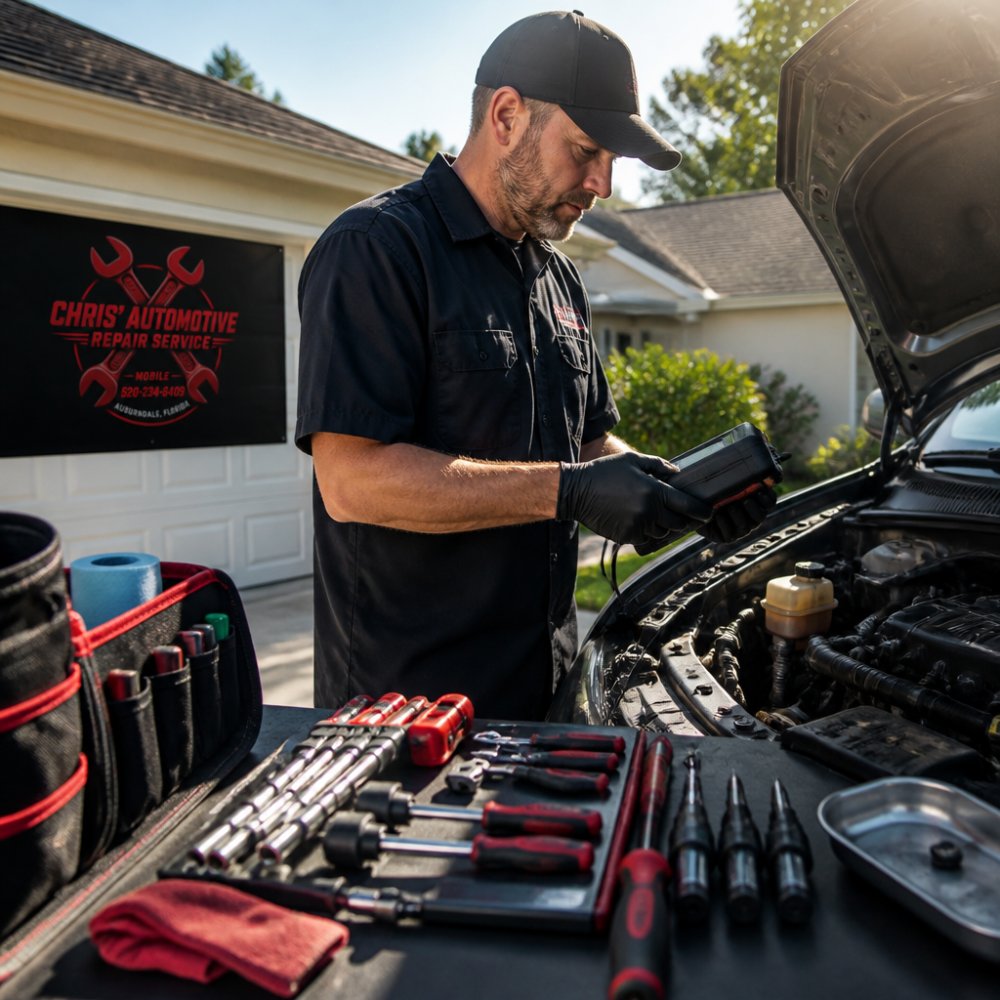
Step 4: Schedule and prepare the space. Confirm the address, parking situation, and a time window. Then get the vehicle ready.
Before the mechanic arrives:
- Park the vehicle on a level, solid surface with room to open the hood and doors
- Clear the area around the car of bikes, toys, and clutter
- Have the keys, registration, and any recent repair receipts handy
- Note when the symptom appears (cold start, braking, turning, highway speed)
- Confirm the vehicle is accessible and that any HOA or apartment rules allow on-site work
- Be present, or arrange for someone to provide access and approve work
What to expect during the visit: Most jobs take one to three hours depending on complexity. The mechanic will diagnose first, confirm the repair, and then complete the work. If the diagnosis reveals a job that needs a lift or specialized equipment, you should be told before any work begins so you can decide between a referral and a tow.
Verifying Credentials and Understanding Your Warranty
Most pages about mobile mechanics focus on whether someone will come to you. Fewer explain how to confirm the person showing up is qualified, insured, and accountable for the work. Use this checklist before you book.
Credentials
- Ask for the technician's ASE certification status. ASE (the National Institute for Automotive Service Excellence) certifies technicians by specialty, and a legitimate tech can show a current credential card.
- Ask how long they have worked in the field and on your type of vehicle. Experience across makes and models matters for accurate diagnosis.
- Confirm they can explain the repair in plain language. A qualified mechanic can describe the likely cause and the fix without hiding behind jargon.
Insurance and business legitimacy
- Ask whether the business carries liability coverage for on-site work. This protects your property if something is damaged during the repair.
- Confirm a business name, a phone number you can call back, and a way to receive a written estimate or invoice.
- Be cautious of anyone who quotes a firm price without seeing the vehicle or asking detailed questions. Accurate estimates require diagnosis first.
Warranty terms
- Ask what the workmanship warranty covers and for how long. A common pattern is a stated period during which a repair that fails due to workmanship is redone at no charge.
- Ask whether parts carry a separate manufacturer warranty and who handles a parts claim.
- Get the warranty terms confirmed in writing or at least clearly stated before work begins, so there is no dispute later.
Reviews and references
- Read recent reviews for punctuality, communication, and whether repairs held up.
- Ask past customers whether the mechanic explained the work and honored the estimate.
Conclusion
A mobile mechanic can absolutely fix your car at home. Most repairs that keep vehicles running happen perfectly well in a driveway or parking lot. The real advantage is convenience, no waiting rooms, no drop-off hassles, no tow trucks. You get professional diagnostic service and repair work right where your vehicle sits.
Chris Automotive Repair Service brings ASE-certified expertise directly to you throughout the week. With over 15 years of hands-on experience across all vehicle types, we diagnose problems accurately and fix them efficiently at your location. Call us today to discuss your vehicle needs and get a personalized quote.
Frequently Asked Questions
What repairs can a mobile mechanic do at home?
Mobile mechanics handle brake repair, battery service, electrical diagnosis, A/C repair and diagnosis, engine diagnostics, suspension work, and check engine light diagnosis at your home. They bring their own tools and parts for most common repairs. Work that requires a lift, specialized alignment equipment, or extended shop time typically needs a facility instead.
Can a mobile mechanic diagnose a car that won't start?
Yes. Mobile mechanic diagnostics can identify why your car won't start, dead battery, alternator failure, starter issues, or fuel system problems, right at your location. The mechanic performs a diagnostic service on-site and can often fix the problem immediately if parts and equipment are available, or provide a clear estimate for repair.
How do I know if a mobile mechanic is ASE certified?
Ask for proof of ASE certification before booking. Legitimate ASE-certified mechanics can provide their certification number, which you can verify on the ASE website. Check for liability insurance and ask about warranty coverage on repairs. A qualified mechanic with 15+ years of experience will have no problem sharing credentials and standing behind their work.
What should I prepare before the mechanic arrives?
Clear your driveway or parking area of obstacles so the mechanic has safe access to your vehicle. Make a list of symptoms or problems you've noticed. Ensure the vehicle is parked on level ground if possible. Have your keys ready and be available to answer questions about your vehicle's history and any recent issues. This helps the mechanic work efficiently and accurately.